




 Identifying as a Jew



6 min read


This well-meaning book ends up distorting the Holocaust.
Soon there will be no more eyewitnesses. The Holocaust is inexorably moving from personal testimony to textual narrative.
Survivors, those who clung to life no matter how unbearable so that they could confirm the unimaginable and attest to the unbelievable, are harder to find after more than half a century. It is the written word that will have to substitute for the heart-rending tales of woe shared by those who endured hell on earth. That is, after all, all that will remain of six million victims.
Holocaust authors have a daunting responsibility.
Holocaust authors have a daunting responsibility. They must speak for those who cannot, but whose suffering demands to be remembered and whose deaths cry out for posthumous meaning. Their task transcends the mere recording of history. It is nothing less than a sacred mission. Holocaust literature, like the biblical admonition to remember the crimes of Amalek, deservedly rises to the level of the holy.
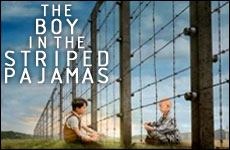
For that reason I admire anyone who is courageous enough to attempt to deal with the subject. No, there will never be too many books about this dreadful period we would rather forget. No, we have no right to ignore the past because it is unpleasant or refuse to let reality intrude on our preference for fun and for laughter. And John Boyne is to be commended for tackling a frightening story that needs to be told to teenagers today in The Boy in the Striped Pajamas -- a fictional account of the Nazi era that uses the powerful device of a tale told from the perspective of its nine year old hero.
I came to this book fully prepared to love it. Although the publisher insists that all reviewers not reveal its story, the back cover promises "As memorable an introduction to the subject as The Diary of Anne Frank." And indeed the writing is gripping. The style, sharing with Anne Frank the distinctive voice of youth, is extremely effective. One can readily understand why the book has had such a strong impact on countless readers, become required reading in high school Holocaust courses round the country, and is about to be released as a major motion picture.
And yet…
How should one react to a book that ostensibly seeks to inform while it so blatantly distorts? If it is meant as a way of understanding what actually happened -- and indeed for many students it will be the definitive and perhaps only Holocaust account to which they will be exposed -- how will its inaccuracies affect the way in which readers will remain oblivious to the most important moral message we are to discover in the holocaust's aftermath?
Without giving away the plot, it is enough to tell you that Bruno, the nine-year-old son of the Nazi Commandant at Auschwitz (never identified by that name, but rather as "Out-With" -- a lame pun I think out of place in context) lives within yards of the concentration camp his father oversees and actually believes that its inhabitants who wear striped pajamas -- oh, how lucky, he thinks, to be able to be so comfortably dressed --spend their time on vacation drinking in cafes on the premises while their children are happily playing games all day long even as he envies them their carefree lives and friendships! And, oh yes, this son of a Nazi in the mid 1940's does not know what a Jew is, and whether he is one too! And after a year of surreptitious meetings with a same-aged nine-year-old Jewish boy who somehow manages every day to find time to meet him at an unobserved fence (!) (Note to the reader: There were no nine-year-old Jewish boys in Auschwitz -- the Nazis immediately gassed those not old enough to work) Bruno still doesn't have a clue about what is going on inside this hell -- this after supposedly sharing an intimate friendship with someone surrounded by torture and death every waking moment!
According to the book's premise, it was possible to live in the immediate proximity of Auschwitz and simply not know -- the defense of those Germans who denied their complicity.
Do you see the most egregious part of this picture? As Elie Wiesel put it, the cruelest lesson of the Holocaust was not man's capacity for inhumanity -- but the far more prevalent and dangerous capacity for indifference. There were millions who knew and did nothing. There were "good people" who watched -- as if passivity in the face of evil was sinless. If there is to be a moral we must exact from the Holocaust it is the "never again" that must henceforth be applied to our cowardice to intervene, our failure to react when evildoers rush in to fill the ethical vacuum.
Yet if we were to believe the premise of The Boy in the Striped Pajamas, it was possible to live in the immediate proximity of Auschwitz and simply not know -- the very defense of all those Germans after the war who chose to deny their complicity.
True, Bruno in the story was but a boy. But I have spoken to Auschwitz survivors. They tell me how the stench of burning human flesh and the ashes of corpses from the crematoria filled the air for miles around. The trains traveling with human cargo stacked like cordwood screaming for water as they died standing in their natural wastes without even room to fall to the ground were witnessed throughout every countryside. Nobody, not even little German children who were weaned on hatred of the Jews as subhuman vermin could have been unaware of "The Final Solution." And to suggest that Bruno simply had no idea what was happening in the camp his father directed yards from his home is to allow the myth that those who were not directly involved can claim innocence.
But it's only a fable, a story, and stories don't have to be factually accurate. It's just a naive little boy who makes mistaken assumptions. However that misses the point. This is a story that is supposed to convey truths about one of the most horrendous eras of history. It is meant to lead us to judgments about these events that will determine what lessons we ultimately learn from them.
So what will the students studying this as required reading take away from it? The camps certainly weren't that bad if youngsters like Shmuley, Bruno's friend, were able to walk about freely, have clandestine meetings at a fence (non-electrified, it appears) which even allows for crawling underneath it, never reveals the constant presence of death, and survives without being forced into full-time labor. And as for those people in the striped pajamas -- why if you only saw them from a distance you would never know these weren't happy masqueraders!
My Auschwitz friend read the book at my urging. He wept, and begged me tell everyone that this book is not just a lie and not just a fairytale, but a profanation. No one may dare alter the truths of the Holocaust, no matter how noble his motives.
The Holocaust is simply too grim a subject for Grimm fairytales.







and I’m supposed to listen to someone who can’t spell or use the correct words? “If there is to be a moral we must exact from the Holocaust it is the "never again" that must henceforth be applied to our cowardice to intervene, our failure to react when evildoers rush in to fill the ethical vacuum.” boo boo, I think you meant extract. also you said “And to suggest that Bruno simply had no idea what was happening in the camp his father directed yards from his home is to allow the myth that those who were not directly involved can claim innocence.” Schmuel was an innocent child (even though you did say he would have been gassed immediately) who didn’t understand anything that was going on so he can’t claim innocence since he wasn’t directly involved? wow.