

 Iran’s Attack on Israel

8 min read


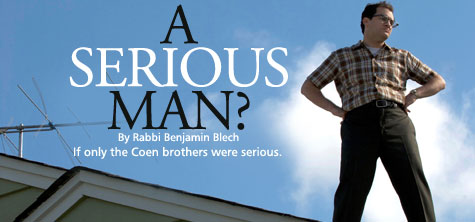
If only the Coen brothers were serious.
Stay until the very end of all the credits at the conclusion of the Coen brothers new movie, A Serious Man, and you'll see something I'm certain has never been done before in the history of Hollywood cinema. Viewers are reassured that, "No Jews were harmed in the making of this motion picture."
Unfortunately the statement is a blatant lie.
The harmed victims run the gamut from rabbis to God -- all of whom are mercilessly mocked in what is purported to be a modern day retelling of the biblical book of Job.
"No Jews were harmed in the making of this motion picture." Unfortunately the statement is a blatant lie.
Let's state at the outset that the Coen brothers are master craftsman. And that's precisely what makes the failures of this film so troublesome. Because they've won Oscars before, this movie is assured keen interest and attention. But David Denby, cinema critic of the New Yorker magazine, got it exactly right when in his review he wrote, "As a piece of moviemaking craft, A Serious Man is fascinating; in every other way, it's intolerable."
The film's emphasis on Jewish themes is probably more pervasive than any other film in recent memory. Would you believe an opening quote, without any elaboration, from the greatest of all Jewish biblical commentators, Rashi, followed by an eight-minute segment of an Eastern European shtetl story including a dybbuk, acted entirely in Yiddish with English subtitles!
What follows, seemingly unconnected to the prologue, is the harrowing tale of the endless misfortunes besetting Larry Gopnick, the 1967 Minneapolis suburban Jewish stand-in for the ancient Job. They are the contemporary equivalents of biblical curses: the imminent breakup of his marriage -- his wife wants to leave him for an obnoxious, smarmy character reverentially admired by his rabbi as "a serious man;" a career-threatening attempt to bribe him to change one of his students grades that leaves him threatened with a lawsuit for defamation; a son about to be bar mitzvahed addicted to pot and rock 'n roll and a daughter desperate to get a nose job as the American-Jewish rite of passage, joined by the moocher brother who moves in with no intention of ever leaving or getting a job.
As the world around him progressively falls apart, Larry wants to know why. Even though in his role as a junior professor of physics he teaches his classes the Uncertainty Principle, he still wants to believe that life makes some sense. He has been a devoted family man, a quiet neighbor, a hard-working professor -- an almost too-good-to-be-true man who turns down the advances of his seductress neighbor. If he cannot turn directly to God for an answer he contents himself with seeking a response from His rabbinic messengers. Surely those who carry the modern mantle of spiritual leadership must have some wisdom to impart to him.
So Larry meets with three spokesmen for the Almighty. And this is where the Coen brothers, who themselves grew up in a suburban area outside Minneapolis "detesting Hebrew school and their boring rabbis" at long last exact their revenge.
Each one of these encounters is more than black humor; it's defamation. Of course there will be those who will immediately counter my criticism with the putdown, "What's the matter, can't you take a joke?" But I somehow can't think it's funny when a film that sets out to explore a contemporary response to the why of human tragedy only finds it possible to offer us three eccentric fools as representatives of the wisdom of Judaism as it confronts the problem of human suffering.
Every meeting between Larry and a rabbi is a comedy "shtick." The first modern "prophet" is the young assistant standing in for his senior rabbi. The inanities coming out of his mouth, asking Larry to consider the beauty and profundity of the outdoor parking lot as a theological statement, elicited loud guffaws of laughter from the audience where I watched it. "What an idiot!" one man actually yelled out in the theater.
So Larry pleaded and actually got to meet an older rabbi. Here surely, I hoped, some semblance of wisdom would substitute for immature ramblings. But this meeting turned out to be even more preposterous than the first. To a man groping for guidance, the rabbi only had a meaningless story -- a story we later learn was a pat response to almost every questioner -- about mystical encrypted Hebrew messages in the teeth of "a goy" that begged God for help. Please don't ask what the story means. Although it's played out with flashbacks and is fully developed, it's obviously only meant to serve as a replay of the theme that rabbis masquerade as scholars, using nonsensical stories as substitutes for valid insights.
Larry desperately seeks a meeting with the third rabbi, the man commonly spoken of with awe as "the best and the brightest." He pleads with the rabbi's secretary for just a few moments time with the person whose profession obligates him above all to be available to the needy, the troubled, the seekers of spiritual solace. After venturing into the office in which we see the rabbi alone, the secretary returns to tell Larry that the rabbi is too busy to see him. When Larry, who noticed there was nobody with the rabbi, asked what he was busy with, he's told, "He is busy thinking."
The film offers no theological explanations for God's silence in the face of evil, only cheap gimmicks at the expense of the Creator.
Take that, all you rabbis who dared to mess with the Coen brothers when they were kids! Nobody will ever take you seriously any more.
And wait till you see what they did to the Hebrew school teacher in the movie. "No Jews were harmed in the making of this movie" indeed -- merely lampooned, satirized and stereotyped to anti-Semitic perfection.
But the one who suffers even more as victim of Coen mockery than rabbis and teachers is none other than God himself. With no defender of His ways other than the incompetent fools posing as spiritual leaders, the Almighty's mismanagement of the world deserves only scorn and laughter. Since the Coen brothers can claim no familiarity with theological explanations for God's silence in the face of evil -- a subject of monumental concern and discussion by some of the greatest rabbinic minds of the centuries -- they are left only with cheap gimmicks and snide jokes at the expense of the Creator.
The only answer they indirectly imply as a Jewish response to human suffering is remarkably enough a Christian approach thoroughly rejected by Judaism. The prologue, with its shtetl fantasy ghost tale, leaves us with a shrieking Jewess convinced that her family will now be cursed for generations -- shades of original sin and children being punished for the sins of their parents. So suburban Milwaukee Jews must end up suffering hundreds of years later to validate a religious concept embraced by others and considered untenable by Jewish faith that is guided by the biblical pronouncement that "children shall not be put to death for the sins of their fathers nor fathers put to death for the sins of their children"!
Remarkably enough, the time period covered by the film is 1967. No Jew sensitive to momentous moments of history can fail to recall that it was this very year that allowed us to witness a miraculous divine response to the suffering of the Jewish people. In 1967, in all of six days, Israel achieved a military victory that stills strains credulity and was viewed by millions as a supreme example of the hand of God in history. Indeed, many mark it as the true beginning of the Ba'al Tshuvah movement, the emergence of a powerful resurgence of returnees to Judaism, to God, and to religious commitment.
Nowhere in A Serious Man is there any hint of these historic events taking place contemporaneously with personal questioning of God's presence in human affairs, events that might allow for far greater perspective and understanding. Nowhere, in fact, in the movie is there anything serious to be found about the most serious question of our lives. The problem that Job immortalized, the Coens have trivialized. And to turn Job into a joke leaves us wishing that a truly "serious man," rather than two disgruntled Jews, would have taken up the noble challenge of a modern-day biblical sequel.