

 Iran’s Attack on Israel

7 min read


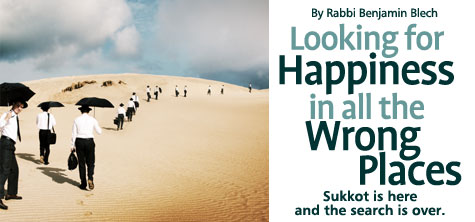
Sukkot is here and the search is over.
This past spring one of Hollywood's most iconic figures passed away.
Elizabeth Taylor will always be remembered for her legendary beauty. Surely her claim to fame is not as a philosopher. Yet, some years ago, she responded to an event in her life with an insight that deserves to be remembered for its profound truth.
Remarkably enough, it is an idea that perhaps best captures the purpose of the holiday of Sukkot which follows immediately on the heels of Rosh Hashanah and Yom Kippur.
Thieves had broken into her safety deposit box. They stole a considerable amount of expensive jewelry. Reporters asked her after she learned of her loss: "Did you cry?" Her answer was simple: "I don't cry for things that won't cry for me!"
"I don't cry for things that won't cry for me!"
In Jewish tradition, there’s a saying that during our lifetimes we have three main friends — and when we die, they leave us in exactly the reverse order in which we treated them. No sooner does our soul leave our body, than all of our wealth flees with it as well. Families are more faithful. They walk with us after our passing to the cemetery, our final resting place. Then, they too leave us to go on with their lives. It is only our name, the good deeds we performed for others, and the influence we may have had upon them, that outlive us and offer us a share of immortality.
Strange then, isn’t it, that we spend most of our lives chasing after money, spending far less of our time than we should with our families, and spending so little of our efforts to accomplish those things by which we will be remembered!
Maybe we can even identify with the profound words of the contemporary author Emile Henry Gauvreay: “I was part of that strange race of people aptly described as spending their lives doing things they detest to make money they don’t want, to buy things they don’t need, to impress people they dislike.”
Related Article: Sukkot and the Secret of Happiness
Sukkot is the one holiday in the year that according to the Torah is meant to teach us all about happiness. Its subtitle is "the season of our rejoicing." For farmers of old it was the time, as they completed their harvest, that they were the wealthiest they would be all year. After all the work they had put in to grow their crops, they were rich.
And so what did the Torah tell us to do to make sure we didn't confuse material wealth with true happiness? We were commanded to leave the luxury of our homes to sit in little frail huts with our families and loved ones.
If we really want to be happy, the first step is to define what it is that will bring us this desired state.
There’s a famous story of a drunk standing under a street lamp carefully searching for something. A policeman comes along, asks him what he’s looking for, and the man answers, “My keys.” Now they both search. After a while, the policeman wants to know whether the man is sure that he lost his keys here. The drunk answers, “No, not here. I lost them back there — but there it’s much too dark to find them.”
Foolish? Of course. But a beautiful illustration of a common failing of mankind. We keep looking for things in all the wrong places. We rationalize that “the light is better here,” but we never stop to ask ourselves if it’s possible that what we’re looking for isn’t really in the place where we’re searching.
“Before we set our hearts too much upon anything, let us examine how happy they are who possess it.” That was the brilliant advice of Francois Duc de La Rochefoucauld. We set our hearts upon wealth. Why not examine how happy they are who possess it? Is there really a correlation between having and happiness, between lack of money and misery?
There is no correlation whatsoever between income and happiness.
Joe Dominguez and Vicki Robin, authors of Your Money or Your Life asked over one thousand people from the United States and Canada to rate themselves on a happiness scale of one (miserable) to five (joyous), with three being “can’t complain.” Dominguez and Robin were surprised to find there is no correlation whatsoever between income and happiness. In fact, once the simplest basic needs were taken care of people earning less reported being happier than those considered upper-middle-class.
“Psychologists have spent decades studying the relation between wealth and happiness,” writes Harvard University psychologist Daniel Gilbert in his best-selling Stumbling on Happiness, and they have generally concluded that “wealth increases human happiness when it lifts people out of abject poverty and into the middle class but that it does little to increase happiness thereafter.”
It’s about time we faced up to the truth: More things don’t mean more happiness. The anonymous line, “Those who say that money can’t buy happiness don’t know where to shop,” may be funny, but it isn’t fact. David Myers, professor of psychology at Michigan’s Hope College, in his book, The Pursuit of Happiness: Who Is Happy—and Why?, quotes a student from an extremely wealthy home: “My parents bought me a Mazda 626. Then one year, my stepfather gave me a sailboat. Later he bought me my own Windsurfer. Our house has two VCRs and three Hitachi televisions. Do these things make me happy? Absolutely not. I would trade all my family’s wealth for a peaceful and loving home.”
So now that we’re crying over our losses in this beaten-down economic climate, let’s reflect on what really deserves our tears. We want above all to be happy. Our culture keeps telling us that the way to be happy is to have more money. Then we can buy more things that will give us more pleasure. When they don’t, we’re told that we really need even more money to buy bigger and better things, so that’s why we have to take on more work and more stress — because then we’ll really be happy. And as we see less and less of our family and accumulate more and more possessions, we end up discovering the truth of the warning in the Talmud’s Ethics of the Fathers that "The more property, the more worries".
“Wealth is like health: Although its absence can breed misery, having it is no guarantee of happiness,” summarizes Dr. David Myers. “If anything, to judge by soaring rates of depression, the quintupling of the violent crime rate since 1960, the doubling of the divorce rate, and the tripling of the teen suicide rate, we’re richer and less happy.”
“Satisfaction isn’t so much getting what you want as wanting what you have."
“Satisfaction isn’t so much getting what you want as wanting what you have. There are two ways to be rich: One is to have great wealth, the other is to have few wants,” Myers says. “Find ways to make the most of the money that does pass through your hands and never lose sight of all that is far more important than money.”
And what is it that is far more important than money?
Sukkot, the holiday of our rejoicing, reminds us that even the frailest hut filled with those we love is a far greater source of happiness than the most luxurious mansion. It tells us not to care more about things than about people. It teaches us to reflect far more on what we have than to be depressed by what we lack.
As we sit in the sukkah and gaze up to the heavens above we will find the reassurance of divine guidance, protection and blessing - which the wisest of all generations have invariably concluded is the best source for finding happiness.