
 Identifying as a Jew


5 min read


Chanukah and the murder of my son taught me a new way of seeing.
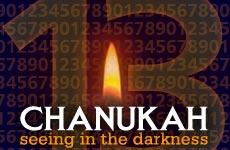
Chanukah is a holiday that helps me understand the fallibility of numbers.
My son Koby was murdered at the age of 13, a prime number, divisible only by itself. Prime numbers are a special category. Nothing else can enter them. My son's death is like a prime number, a kingdom I cannot fathom. When I think of Koby, I am left with something I cannot divide. Every time I think of him, every hour of every day, I am left with a mystery.
Does Koby age in heaven? Or will he always be 13? To attach a number to him is meaningless. He has left the world of numbers.
Now Koby would be 15. Does he age in heaven? Or will he always be 13? To attach a number to him is meaningless. He has left the world of numbers. I have a friend whose 20-year-old brother was in a coma for 13 years. It was exceedingly painful for her to see her brother age, his hairline recede. His body was a shell for his soul. He was still in the world of numbers, but there was no category that fit him.
When I am asked how many children I have, how should I answer? Do I count Koby? How can I not? How can a number describe my desire for him?
There is a picture in my daughter's room that shows Koby and me together at a bar mitzvah, two months before he was killed. What I see in my eyes is how proud I was to be his mother, how proud that a brilliant beautiful child like Koby was in my life. I had such a feeling of ownership with him. I felt like he was mine, almost like I had created him. Though now, I see, I never owned him. Because if I had, I would never have allowed him to be taken from me and from this world.
I used to think that life was about acquiring and creating and keeping things whole. But now, when my arm still reaches for four chocolate pudding treats on the shelf of the supermarket even though one of my four children is dead, I see that life is about learning how to see in the darkness.
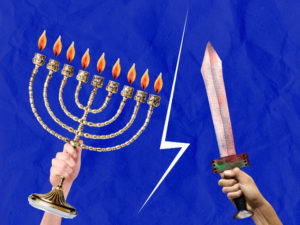
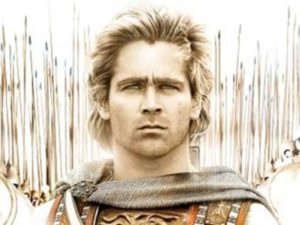
Chanukah is also about learning a new way of seeing. The Maccabee's war against the Hellenists was a fight not just for territory but also for a worldview. The Greeks believed in the grace of beauty, the redemptive powers of humanity. For the Hellenists, beauty was holiness. For the Maccabees, holiness wasn't always visible -- but was the manifestation of the justice and goodness of God. For the Hellenists, the body was perfection. For the Maccabees the body was an instrument to be used for serving God.
The Maccabees insisted on giving tribute to God and his laws, and his temple. When the Maccabees were victorious and reentered the temple, there was just a little oil left to light the menorah, enough for one day. Nevertheless they kindled the flame and the oil lasted for eight days. Many people believe that this is the miracle of Chanukah.
But maybe it wasn't a miracle at all. Perhaps one vial of oil can always be enough for eight nights if we look at our lives as a place for God to dwell. Because God is infinite, when we approach the Divine, we leave the world where numbers circumscribe reality. Once we make a sanctuary for God, then the infinite possibilities of God dwell within us as well. Numbers become guides, instead of rulers.
Chanukah teaches us that what we see in this world is a glimmer of the truth. Our measurements in this world are imprecise, our ways of knowing limited. The world of truth is not one where the numbers we ascribe to reality are sufficient. One vial of oil becomes eight.
It's not easy to see in the dark, but you don't need that much oil to fill the darkness.
Thus it is fitting that Chanukah begins during the month of Kislev, the month of dreams and sleep. As we near the winter solstice, we prefer more and more to stay in bed. Many of the Torah portions of this month speak of sleep and dreams -- Jacob has his dream of a ladder and God speaking to him; Pharaoh has dreams that need to be interpreted.
Chanukah itself has the logic of a dream. In sleep we have access to a different world -- a world where what is impossible during the day becomes possible. In sleep, the few can become many. The light at night is a deeper light with a greater capacity for revelation. This is the light of Chanukah. This is the light of holiness.
It's not easy to see in the dark, but you don't need that much oil to fill the darkness. A small measure can easily expand to light the largest cavern. The Kaballah tells us that we are like flames, the spark of our souls reaching toward the candle of God.
To see God in my life, I have to see in the darkness -- to see beyond what appears to be, to stop counting with ordinary integers of ownership -- to see what is blurred, undefined, beyond my ordinary senses. Chanukah tells me that what matters is not how old Koby is now -- I can't count him anymore with my daytime logic. But I can create a sanctuary inside of me -- a place of holiness where his death matters, a place where I consecrate the light of his soul so that it shines within me.