 Dostoevsky Was an Antisemite. I Still Think You Should Read Him


12 min read


Detailed guidelines for ensuring that your sukkah is 'kosher'.
According to most opinions, one should begin on at the departure of Yom Kippur in order to go immediately from one mitzvah to another. If this is not possible, one should begin the following morning. If this will not leave him sufficient time to complete the Sukkah, one may begin to build before Yom Kippur, but he should not place the s'chach until after Yom Kippur. According to some opinions, one should begin to build the Sukkah before Yom Kippur, as an added merit.
Ideally, the Sukkah should be completed on the day after Yom Kippur. However, if by doing so, the Sukkah will not be built properly and sturdily, he should devote more time to erect a better and more beautiful Sukkah.
Yes, but one must stop building at halachic midday. According to some opinions, one may continue to build until mincha ketanah (two-and-a-half halachic hours before sunset).
If a person did not build a Sukkah before Yom Tov, or if he built one but it fell down, he may build one on chol hamoed. If necessary, even skilled work (which is usually forbidden on chol hamoed) is permitted in order to fulfill the mitzvah, but if possible this type of work should be avoided and the Sukkah should be a simple construction.
Any person may build a Sukkah, including women and children. However, it is a mitzvah for every man to participate personally in the building, and whoever toils and sweats with this task receives atonement for serious sins. It is preferable not to ask a gentile to build a Sukkah.
A Sukkah must be built under the sky, with nothing intervening between the s'chach and the sky. One must be careful not to build a Sukkah under:
If the section under the sky has sufficient walls and the minimum dimensions, the Sukkah is kosher. Nevertheless, one may only eat in the part of the Sukkah that is under the sky. Sometimes, the invalid section may be included in calculating the size of the Sukkah and a rabbi should be consulted.
Ideally, one should chop off these branches. If one did not do so, the Sukkah is still kosher even when the branches are swaying over the s'chach.
Yes. Since the lines are very narrow and there is space between them, they do not invalidate the Sukkah. This is true even when laundry is hanging from the lines. However, if the laundry becomes entangled in the lines, the area of the s'chach beneath is invalidated. In some situations, this may invalidate the entire Sukkah.
In Israel, this is allowed since permission is automatically granted to use the street for this purpose.
In the diaspora, one should ideally avoid doing this unless specific permission is obtained from the authorities. However, the custom is to be lenient in this matter if no other area is available, especially if the Sukkah is built close to the house.
On soil is permitted, but it is forbidden to sweep the floor on Shabbat and Yom Tov. It is therefore advisable to cover the floor with some suitable flooring.
On grass is not advisable since it is difficult to avoid spilling liquids on the grass on Shabbat and Yom Tov. The grass should be covered with suitable flooring.
Since a Sukkah is only a temporary dwelling, it does not require a mezuzah.
The inside of the Sukkah must measure at least seven tefachim long by seven tefachim wide. This is the smallest area in which a person could reasonably be expected to sit. (Even if the Sukkah is very long, it must still measure at least seven tefachim wide.)
In practice, this means that the Sukkah should preferably measure 70cm x 70cm. It is still kosher if it measures only 56cm x 56cm.
The internal height should measure at least 1m, but it is still kosher if it measures only 80cm.
There is no limit to the size of a Sukkah. In terms of height, however, the s'chach must not be higher than 20 amot from the floor of the Sukkah (approx. 10 meters). This is rarely applicable.
Strictly speaking, a Sukkah may be kosher even if it has less than three complete walls. However, the custom is to build a Sukkah with four complete walls to avoid complications. In order of preference, a Sukkah should have:
The walls may be made from any sturdy material.
The walls must be strong enough to remain in position when the wind blows. Therefore, sheets that flap may not be used. Ideally, one should not even use sheets that are firmly tied down on all sides, in case they become detached and this goes unnoticed. If three walls are made from sturdy materials, one may use sheets for the fourth wall.
If no alternatives are available, one may use sheets that are tied down on all sides. In this situation, it is preferable to tie several horizontal strings around the Sukkah. These strings should be tied at intervals of less than 24cm, to a height of at least 80cm (preferably to a height of 1m). This method invokes a halachic principle that considers the strings to be united to form a solid wall. With such strings, the Sukkah is kosher according to all opinions.
The walls must be at least 80cm high (preferably 1m) but do not need to reach the s'chach. It is perfectly acceptable to support the s'chach on wooden posts etc, if the walls are the minimum height. The remaining spaces may be left open or filled with sheets or any other material. In this situation, the s'chach should preferably reach the line directly above the wall.
The walls do not need to touch the ground, but they must not be raised more than 24cm above it.
The Torah requires one to use a material that satisfies these three conditions:
According to one opinion, the best s'chach is cut branches of trees. This is hinted by the numerical value of the word Sukkah (91) which is identical to that of the word tree ('ilan').
Most are kosher, but one should not use the following types:
It is forbidden to fulfill a mitzvah through stealing. Therefore, permission must be obtained before cutting any such trees, unless one is certain that they are ownerless.
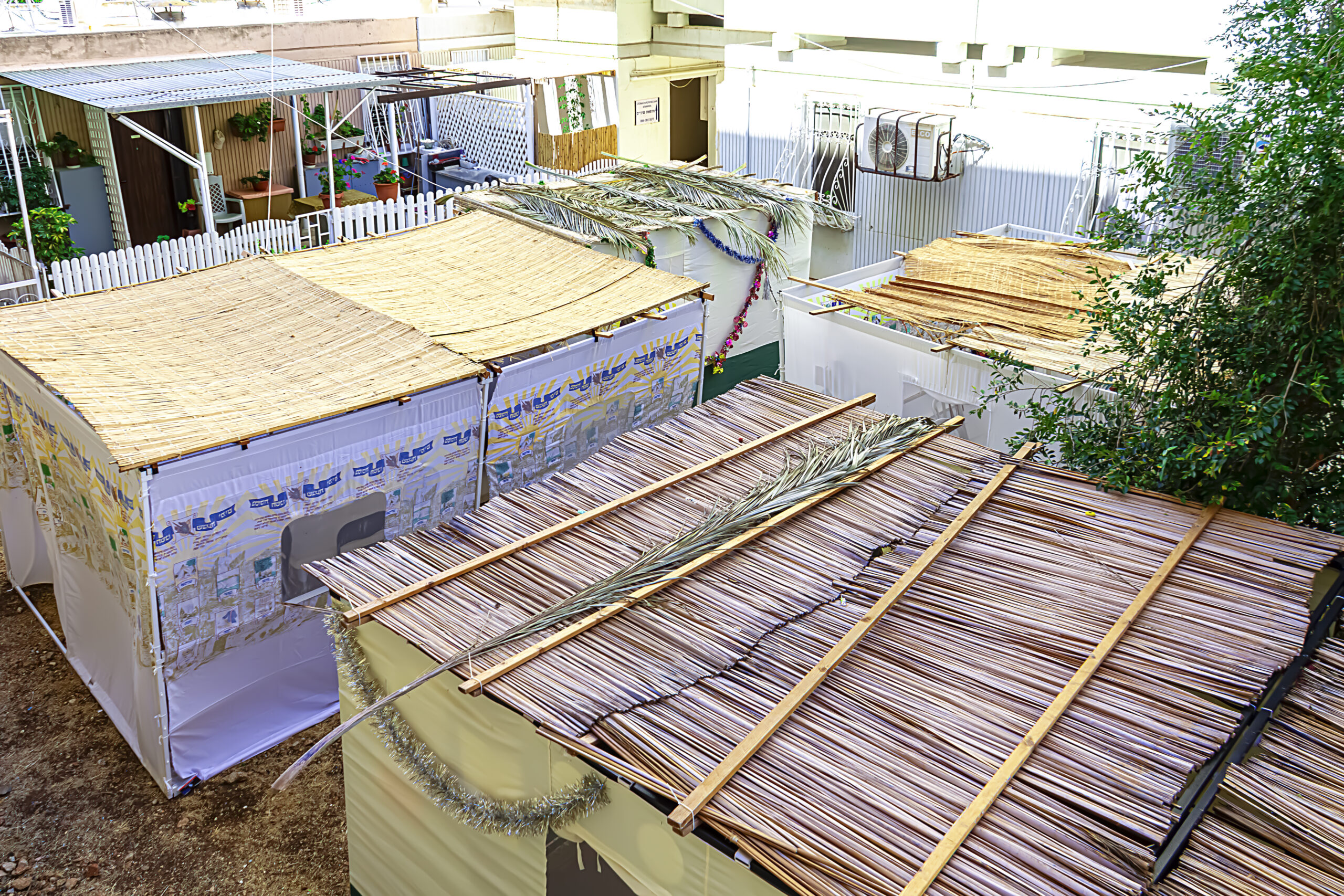
It is forbidden to use wide planks for s'chach, since the Sukkah would then appear like a house. Therefore, one may not use planks that are wider than 8cm, and preferably not wider than 5cm. Narrow planks may be used, although they are disqualified by some opinions.
When pieces of s'chach are interwoven or connected to each other, they may be disqualified since they now may be capable of becoming tamei. Since these laws are complex, one should not use such matting or wickerwork unless it has a reliable rabbinic supervision.
One must use sufficient s'chach to cover the majority of the area of the roof. In other words, the total area of the open spaces must be less than the area covered.
If the s'chach is dense in some areas but sparse in others, then the Sukkah is kosher if the following two conditions are fulfilled:
Yes, unless the area measures seven by seven tefachim. It is advisable to spread the s'chach evenly, so that every part of the Sukkah is covered sufficiently.
There are several levels of permissibility:
No, but the s'chach must reach within 24cm of the walls. Nevertheless, one must not sit next to the wall under the empty space, unless it is less than 20cm.
If the space between the s'chach and the wall is more than 24cm, then the wall next to the space is invalid and cannot be used as one of the three minimum walls. If the s'chach reaches the other three walls then the Sukkah is kosher, but if two walls are invalidated then the entire Sukkah is invalid.
To correct such a situation of large gaps (more than 24cm) between the s'chach and the walls, one should fill them in. Sheets, metal, boards or anything else may be used, although these items may not be used as s'chach. This method invokes a halachic principle called dofen akumah -- a bent wall. We imagine that the wall of the Sukkah extends upwards and then bends in horizontally until it reaches the kosher s'chach. One may not sit under this area of the Sukkah, but only under the kosher s'chach.
This method is permitted provided that the non-kosher s'chach is less than 1.92m wide on at least three sides, and the area of kosher s'chach is at least seven by seven tefachim. This situation is common when making a Sukkah indoors under a removable section of the ceiling.
This should be avoided. Just as the s'chach itself must not be capable of becoming tamei, similarly the supports of the s'chach should not be capable of becoming tamei. Therefore, the s'chach should preferably be placed on wooden beams. In extenuating circumstances, one may use anything as supports for the s'chach. Similarly, if one visits a Sukkah whose s'chach rests on a metal frame, one may eat there and recite the b'racha for the Sukkah.
This is permitted since the metal frame is only a secondary support to the primary wooden supports. According to some opinions, this is true only if the wooden beams are actually assisting in the support of the s'chach (i.e. the removal of the wooden beams would cause the s'chach to fall down). If after removing the wooden beams the s'chach would still rest on the metal frame, the metal frame is considered to be the primary support according to this opinion.
One should avoid using string or nails to support the s'chach. If a person is afraid that the s'chach may slide off or be blown away in a normal wind, he should not tie or nail it down since this is considered a primary support. Rather, he should place heavy planks of wood or branches over the s'chach, since they qualify as kosher s'chach. The planks or branches may be tied or nailed down since the string or nails would then be considered a secondary support. Alternatively, he may tie down the s'chach with vegetation, such as palm leaves, twigs etc. If the s'chach would not be blown away except in an unusually strong wind, it may be tied down even with string. In extenuating circumstances, the s'chach may be tied down with string, even if it may blow away in a normal wind.
Yes, the walls must be constructed before the s'chach is put in place. If the s'chach is placed on a frame and then the walls built, the Sukkah is invalid and the s'chach should be raised and lowered. Similarly, if one needs to use the 'bent wall' method, the 'bent wall' must be constructed before the s'chach is placed.
Excerpted from "Guidelines - Succos" - 400 commonly asked questions about Succos (Targum/Feldheim).