


 Vampire Weekend's Surprising Jewish Stories


4 min read
3 min read
4 min read


7 min read


The "PETA Principle," the moral equating of animals and humans, is an affront to the very essence of Jewish belief.
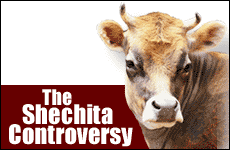
Now that the blood has settled, a clearer perspective might be had about the recent brouhaha over shechita, or Jewish ritual slaughter, at a meat-processing plant in Iowa.
Yes, the beginning of that sentence was meant to jar. Blood and attendant unpleasantness are part and parcel of the process of turning livestock into meat, and most people are content to interact only with the final product.
Some, though, choose not to do even that. They include people who are repulsed by the thought of eating what was once alive, and others who feel that meat consumption is a wasteful use of natural resources. Yet others shun meat for health or religious reasons.
And then there are the folks at People for the Ethical Treatment of Animals, or PETA, who object to all killing of animals because, as Ingrid Newkirk, the group's co-founder and president, famously put it, "a rat is a pig is a dog is a boy" -- because of their belief, in other words, that animals are no different from humans.
The Jewish religious tradition forbids causing animals unnecessary pain. And there are observant Jews who are vegetarians; our tradition even teaches that the first man and woman -- indeed all of humanity until Noah -- were divinely forbidden to eat meat. But the Jewish faith expressly permits the killing of animals for human needs, including food. Which animals may be eaten and how to dispatch them are topics dealt with at considerable length in Jewish legal literature.
Indeed, the "PETA Principle," the moral equating of animals and humans, is an affront to the very essence of Jewish belief, which exalts the human being, alone among God's creations, as, among other things, the possessor of free will, a being capable of choosing to do good or bad. That distinction is introduced in Genesis, where the first man is commanded to "rule over" the animal world.
The notion that humans are mere animals can lead to ethical obscenities, like PETA's "Holocaust on Your Plate" campaign, comparing the killing of chickens and cows to the murder of Jewish men, women and children.
The notion that humans are mere animals can lead to ethical obscenities, like PETA's appeal to the director of the federal penitentiary where Timothy McVeigh was awaiting execution, that the mass murderer not be served meat so that he "not be allowed to take even one more life." Or the group's lodging of a protest with Yasir Arafat over a terrorist attack because the donkey carrying the explosives detonated in the attack was killed. Or its "Holocaust on Your Plate" campaign, comparing the killing of chickens and cows to the murder of Jewish men, women and children. Or solemn declarations like Ms. Newkirk's that "Six million Jews died in concentration camps, but six billion broiler chickens will die this year in slaughterhouses."
And so when PETA launched a media blitz several weeks ago, sending scores of journalists and others copies of surreptitiously filmed and carefully edited videotapes of animals being slaughtered at the AgriProcessors plant in Postville, Iowa - the largest producer of "glatt" -- or highest-standard -- kosher meat in the nation - the immediate reaction on the part of some Jewish organizations and many of those in the kosher food industry was understandably negative.
The video, to be sure, was disturbing. Although the PETA "mole" who secretly recorded the film likely witnessed thousands of unremarkable slaughters during his months on the job, the edited film showed a number of animals that seemed conscious after the act of shechita. In one case, an animal even righted itself and took several steps before collapsing.
Every method of animal slaughter yields a small percentage of such unfortunate results, when some degree of consciousness persists longer than it should. What PETA claims, though, is that what was depicted on its edited video of operations at the Iowa plant represents fully a quarter of the animals slaughtered over the seven-week period during which the video was made.
There is reason to be skeptical about this claim. A subsequent visit to the plant by Dr. I.M. Levinger, a veterinary surgeon and physiologist, yielded his testimony that, of the as many as 150 animals he saw slaughtered over the course of his two-day visit, only a single cow exhibited any conscious activity after shechita.
What is more, USDA inspectors are typically present on the killing floor during animal slaughter, to ensure that the process complies with federal standards. The inspectors present at the Postville plant during the period PETA compiled the images in its video presumably saw the entire picture, and never complained about any inordinately high number of post-slaughter displays of consciousness. A high-level USDA official, for that matter, visited the plant after PETA released its video to personally observe the allegedly inhumane practices and take appropriate action; what he saw apparently persuaded him that there was no need to shut down the plant or alter its basic practices.
Likewise, top officials from the kashrut organizations that certify AgriProcessors' meat visited the plant to monitor the shechita process and found that signs of post-slaughter consciousness were extremely rare. Indeed, Iowa's Secretary of Agriculture, Patty Judge, who had initially expressed her deep chagrin after watching PETA's video -- even calling for a federal investigation -- concluded, after a personal visit to the plant, that the shechita there "... was humane... and there was absolutely no problem with the way they [the animals] were handled."
Those personal observations confirm what scientific theory would have predicted: that the incidence of displays of post-slaughter consciousness is more rare in cases of shechita than when non-kosher methods of slaughter are employed. That is because, as Dr. S.D. Rosen, MA, MD, Faculty of Medicine, Imperial College, London, noted earlier this year in a monograph in the Veterinary Record, studies have shown that after the cutting of the trachea, esophagus and carotid arteries - the shechita process in essence -- an animal's consciousness is lost within approximately two seconds, and irreversibly.
The evidence would appear to suggest, therefore, that PETA is grossly exaggerating the frequency of post-shechita signs of consciousness at the Iowa plant. Perhaps it should not be surprising that PETA's 25% figure differs so dramatically from what others have seen. Because, while the group's concern that animals not be caused unnecessary pain is commendable, PETA also has an ultimate, and openly declared, goal: to stop people from eating meat. And so, if a bit of dissembling is necessary to move in that direction, well... wouldn't you stretch the truth to save Jews from Nazis?
Precision, though, is not the only thing PETA seems prepared to sacrifice in order to achieve its goal. Our nation's commitment to religious liberty, in PETA's eyes, is eminently expendable as well.
Even though the Iowa plant has discontinued a bleeding-facilitating arterial cut that PETA deemed a "dismemberment" of live animals, the animal rights group is now demanding, among other things, that U.S. government regulations regarding animal slaughter be changed in fundamental ways and that the type of restraining pen required by some decisors of Jewish law be outlawed. These are not minor points; they touch, and not gently, upon the issue of rabbinic authority and religious autonomy. And that game is zero-sum: What constitutes proper animal-slaughter methods for observant American Jews will necessarily be determined in the future either by rabbis or by advocates for animal-rights.
Shechita was attacked and outlawed by the Nazis when they came to power in Germany. Today, animal rights activists have succeeded in banning it in several European and Scandinavian countries. If PETA's misleading campaign is not seen for the partisan salvo it is, our own country may be next.
Courtesy of Am Echad Resources