

 An Open Letter to University Presidents



4 min read


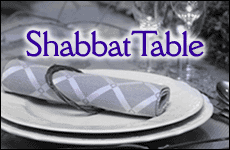
Preparing the Shabbat table -- gleaming silver and satin white - is a labor of love.
One of the joys of Shabbat is the appearance and decor of the table upon which Shabbat meals are served. Shabbat meals are usually festive affairs, served in the dining room rather than the kitchen/breakfast nook where the rushed weekday meals are gobbled down.
The Shabbat meal is leisurely, interspersed with song, discussions of Torah topics and other enjoyable and wholesome conversation. It is the venue for children to tell their families what they've learned that week at school. It also is the setting for hospitality to guests and friends and a time for family anecdotes, reminiscences and bonding.
However, all emotional and spiritual experiences in this world require a physical framework.
The physical setting for the enhancement and release of the Shabbat meal's atmosphere is the Shabbat table itself. There is no more direct and telling lesson that can be taught to the members of the household about the importance of Shabbat than the exhibition of the care and taste involved in preparing the Shabbat table. It is a labor of love, and different assignments regarding the table's preparation can and should be delegated to different members of the family.
It is my personal experience with my children and grandchildren that those who are somewhat reluctant to share the burden of ordinary household chores are far more enthusiastic about fulfilling their obligations when it comes to setting the table for Sabbath.
Beautiful Cloths
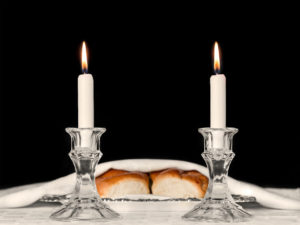
The table is first covered with a Shabbat tablecloth. Such tablecloths are usually white, though they can be of any color. There are even special tablecloths with "Shabbat" embroidery or designs.
The concept of a tablecloth is not only one of beauty and practicality. The Shabbat table, which has two loaves of challah (bread) placed on it, is a symbol of the miraculous manna that sustained the Hebrews during their 40-year sojourn in the Sinai Desert after the Exodus from Egypt. While on normal weekdays only one portion of manna fell for each individual, on Fridays two measures of manna fell in the desert, one measure for Friday and one for Shabbat.
This is the origin of having two loaves of challah on the table for Shabbat meals. The manna that fell in the desert was sandwiched between two layers of dew that protected the manna from the sands below and the dust above it. Therefore, our custom is to sandwich the two loaves of challah between the tablecloth and a special cloth cover. The cover is usually decorated with "Shabbat" embroidery. Thus the tablecloth itself becomes a symbol of Jewish history and memory.
Shabbat Queen
Before the meal, a goblet is placed on the table that will contain wine for the Kiddush blessing. This blessing refers to remembering Shabbat as a gift to Israel by God, and it sanctifies the meal about to be eaten. The goblet is usually made of silver, though almost any material can be used.
The finest dishes, silverware and tableware are used for Shabbat meals. In many homes, especially in Israel, flowers are placed on the table to add their flash of color. They also reflect the beauty of God's world, created in six days before He "rested" on the seventh day, Shabbat. And of course, the glow of candlelight on Friday night casts an atmosphere of spirituality over the entire scene.
The Shabbat table, therefore, is more than just a utilitarian table upon which food is placed and eaten. In the words of the prophets of Israel, the Shabbat table becomes "the table that is placed before the Lord." Shabbat itself is an honored "guest," likened to a queen, in every Jewish home. Therefore, the table set before such an important and beloved guest must reflect the honor, happiness and satisfaction that the members of the household feel at entertaining such a guest in their home. In all of its beauty and dignity, the carefully set table speaks to us of the greatness and holiness of the Shabbat day itself.
Excerpted from "Living Jewish" (ArtScroll/Mesorah)