

 Iran’s Attack on Israel
12 min read


They like us in Poland, now that we're dead.
In late June, before my brother and I and our spouses left for central Europe, I phoned my "Aunt" Regina. Regina's friendship with my mother began in a slave labor camp in Poland. After the war my parents, of blessed memory, and I shared a house with Regina and her husband and son in Germany, and later in New Jersey.
"How do you say ‘please' in Polish?" I asked Regina.
Our first stop would be Krakow. I know a few words from the Polish my parents spoke: tak ("yes"); dobry ("good"); dziekuja ("thank you"). I couldn't remember how to say "please."
"Don't be so nice to them," Regina said with her droll humor, and we both laughed, though she wasn't joking. Most Poles were happy to turn in their Jewish neighbors to the invading Nazis, to steal their property, to make Poland Juden rein -- free of Jews.
"'Please' is prosze," Regina told me.
 Krakow is the next Prague -- charmingly renovated, with a variety of cultural activities and sites of Jewish interest. Our visit coincided with the 17th annual Krakow Jewish Cultural Festival, which drew between 10,000 and 13,000 visitors, most of them non-Jewish Poles and around 100 Jews. But for my brother and me, Krakow's attraction lay in its proximity to the towns where our parents grew up: our father, in Trzebinia; our mother, in Oswiecim (Auschwitz).
During our four days in Poland, with Regina's words in my head, I did say prosze and dziekuja. I said it to the staff at our lovely boutique hotel which overlooks the newly chic Szeroka Square in the Kazimierz, the Jewish quarter. I said it at the Eden, where we ate Shabbat meals with 50 or so Orthodox Jews who were in Krakow for the festival. I said prosze and dziekuja to Andre, the keeper of the key to the Trzebinia Jewish cemetery, where we walked between overgrown shrubs and weeds and searched in vain for family names among the tombstones, many of them felled by the Nazis. In Oswiecim I said prosze and dziekuja to the curator of a small Jewish museum in the Mishnayos shul down the block from the apartment where my mother had lived -- the synagogue where my grandfather and uncles prayed daily before they were deported and later exterminated.
At the museum I bought Lucyna Filip's Juden in Oswiecim: 1918-1941, in German, a language I can't read. But it contains photos and a list of Oswiecim's Jews, with details for each entry: first name and family name, date of birth, first address in the Sosnowitz ghetto, second address. I found my family name. I found entries for my uncle who lives in Israel, for uncles and aunts who were killed. I found my mother's name. Sprinca. And a middle name -- "Sara."
My mother had no middle name. "It's not Mommy," I told my brother, stifling my disappointment.
The curator explained that the Nazis gave all Jewish women the name Sara; all Jewish males were named Israel.
"Dziekuja bardzo," I said to the expressionless clerk as I handed him 60 zloty and clutched the book as though it were a priceless treasure. Thank you very much
It's hard to know what they are thinking, this generation of Poles burdened with a history of collaboration with the Nazis, a history they strive to deny.
It's hard to know what they are thinking, this generation of Poles burdened with a history of collaboration with the Nazis, a history they strive to deny. What am I to make of Andre, who kissed my hand and said he's writing a book about Trzebinia's Jews? Can I trust the smile of the curator, who is eager for family photos for the museum's exhibit? What did the Eden staff think when they saw our yarmulkes and the Chasidic garb of our fellow guests, when they heard our Shabbat songs? Even our tour guide, a non-Jew whose Jewish wife told us her husband is emotionally spent whenever he takes groups to Auschwitz-Birkenau, a guide who speaks with loathing of the Nazis and deplores the commercialization of the Holocaust and the sound bites it provides visiting politicians --even he took pains to tell us, several times, that Auschwitz I, which the Nazis easily converted from a Polish military base to a prison, was initially used to intern Polish gentiles -- doctors, educators, priests, anyone who could offer resistance to the Nazis.
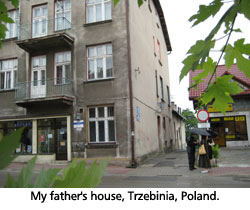 In Trzebinia we encountered a Polish woman whose face revealed what she thought of us. We had finally located our father's three-story house on Ulica Novoskaya, a house that has loomed large in my imagination. Standing in the back yard where my grandfather had built a beis medrash (house of learning) for the Bobover Rebbe and his entourage, I pictured my father behind one of the white lace-curtained third-story windows, playing his violin, perhaps committing to memory a melody the Rebbe had composed at the Friday night's tish. Rain started falling, and a blustery wind inverted our umbrellas. We left and took shelter under a doorway across the street. That's when we saw the old woman. She was coming toward us from the yard where we had stood moments ago. She was glowering at us, her eyes filled with suspicion, the malevolence in her mien and in her plodding footsteps taking on a menacing quality as she came closer.
Several years ago a friend of my parents returned to Poland with her two daughters. She found the house where she had lived and assured the person who opened the door that she hadn't come to press a property claim -- she only wanted to show her daughters the home where she had grown up.
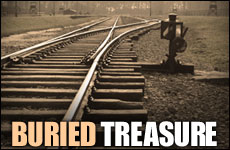
The door was slammed in her face. Before she left, my parents' friend said, in a voice loud enough so that those inside would hear, "It's a shame you didn't let us in. I would have shown you where we buried the treasure."
Within 24 hours, the occupants of her family's home had ripped up all the floor boards searching for that buried treasure.
Later she heard that within 24 hours, the occupants of her family's home had ripped up all the floor boards searching for that buried treasure -- treasure that had never existed.
My brother and I didn't travel to Trzebinia to reclaim our father's house, now a government owned apartment building with an optical shop and hair salons on the ground floor. Over the years the Polish government has stonewalled our attempts. Now they are relaxing their criteria and are allegedly more amenable to making restitution, but I am doubtful. And this policy shift has given rise to (or uncovered?) anti-Semitism, articulated by Tadeusz Rydzy, the voice of Radio Marvia :
"You know what this is about: Poland giving $65 billion to Jews?" Rydzy is quoted as saying. "They will come to you and say, ‘Give me your coat! Take off your trousers! Give me your shoes!'"
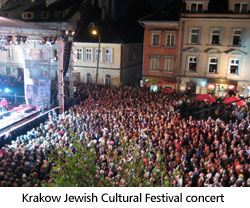
Rydzy's venomous bigotry is clear. It is open and honest. So is the enmity (and fear?) of the woman who lives in what was my grandfather's house. Less clear are the sentiments and motivations of the thousands of non-Jewish Poles -- men, women, and children -- who gathered late Saturday afternoon in Szeroka Square for the festival's finale, an open-air concert that would air the following evening on local TV. There were no seats. People stood for over six hours until well past midnight, their umbrellas mushrooming sporadically in a riot of color against scattered showers that didn't dampen the crowd's enthusiasm. From my second-floor hotel room I watched. They cheered after Theodore Bikel sang Yiddish, Hebrew, and Russian tunes. They swayed and danced as bands played klezmer and rap. They listened when Poland's chief rabbi recited the havdala after the festival director explained the significance and particulars of the ceremony.
The festival director didn't know what a Jew was 17 years ago, didn't know that Krakow was home to 64,000 of us before the Nazis made the city Juden rein. He initiated the festival in the hopes of reviving Jewish culture, of forming a bridge between Jews and Poles. Of healing.
And the crowd? Why are they here? I wondered. What do they think about Jews? Are we a curiosity? We are certainly a tourist attraction, I saw from a "Cracow Tours" pamphlet in our hotel lobby:
"Visit the historical centre for Poland's Jews on a tour of Kazimierz, the district where Schindler's List was filmed."
"Discover the taste of Jewish cuisine and the charm of klezmer music."
"See for yourself where the atrocities of the Nazi's ‘Final Solution' were carried out with a tour to the Auschwitz-Birkenau concentration camp."
You might say this is positive attention, a way to enlighten, to build bridges between Poles and non-Jewish tourists and Jews. But what Jews?
You might say this is positive attention, a way to enlighten, to build bridges between Poles and non-Jewish tourists and Jews. But what Jews? When we asked our guide whether there were Jews in Tzrebinia or Oswiecim, or in Sosnowitz or Bendzin or Chrzanow or Lublin, or other cities where, before the war, the Jewish population was often the majority, his answer was always the same:
"Two: Yoshka and his mother." Jesus and Mary.
Except for Warsaw and Krakow, Poland is Juden rein. Hitler accomplished his goal -- most successfully in Poland, but also in Austria and the Czech Republic and Hungary, where the Jewish populations may be larger, but Judaism is dying, and it isn't safe to walk around wearing a yarmulke.
Still, they like us in Europe. They have erected Holocaust memorials and speak fondly of "our Jews" while they remind us of our kinship -- they, too, were victims of the Nazis. In Vienna our pretty, jaunty guide pointed with pride to sidewalk plaques commemorating Jewish families who lived there before the war -- a Hollywoodlike Walk of Fame -- and accused the media of reporting anti-Semitism where none exists. Prague has a statue of the Maharal, the 17th century Talmudic scholar who created the Golem to save the city's Jews (you can buy Golem souvenirs in shops or in kiosks along the St. Charles Bridge); and on a renovated building in what was the Jewish ghetto you can see an artist's rendering of a Jew -- a lovely tribute, if you ignore the stereotypical long nose and pointy chin. In Budapest the statue of Raoul Wallenberg, the Swedish diplomat who saved thousands of Hungarian Jews (Hungary handed its Jews to the Nazis with ferocious rapidity) and was probably killed by the Russians, was recovered after being missing for years. You'll admire the statue -- if you can find it.
They like us in Europe. They welcome us with entrance fees that allow us to view the empty splendor of our synagogues. They welcome the money we spend on books and postcards that tell the history of these synagogues and their Jews ("There wasn't a ghetto," our Viennese guide said, "just an area where Jews preferred to live"), and on Judaica stolen from murdered Jews and displayed next to Limoge and Rosenthal china and figurines -- a menorah, a kiddush cup, a yad, an esrog box.
They welcome us to Auschwitz-Birkenau, where stretches of barbed wire and concrete posts are new, and where you know that, with every step, you are probably treading on human ashes or bones. (When we were there, the day was obscenely beautiful.)
They welcome us to Auschwitz I, where you can enjoy lunch or a latte in the restaurant adjoining the museum.
They welcome us to Auschwitz I, where you can enjoy lunch or a latte in the restaurant adjoining the museum after you have had your fill of viewing mind-numbing mountains of items stripped from Jews brought there to be worked to death and then killed: eyeglasses, plaits of hair, sewing kits, jewelry, suitcases, dresses, hats, shoes, prosthetics.
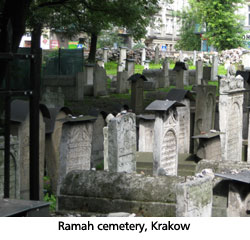
They welcome us to our cemeteries, where we pay to enter so that we can recite Psalms and a "Kel Moleh Rachamim" at the gravesites of the Ramah and the Maharal and so many others of our sages. Our buried treasure. And what of our unburied treasure, the millions whose bodies were never recovered?
They like us in Europe now that we are historical relics on display in breathtakingly magnificent synagogues that were used by the Nazis as storehouses or stables and have been turned into museums and memorials; synagogues where, until the tourists come, almost no one prays and the vaulted ceilings echo the silence. They like us now that we are dead.
Still...
 Krakow is busy planning its 18th annual Jewish cultural festival, and several Jewish performers we spoke to intend to be there. I wonder what they hope to accomplish, whether they felt as disconnected with reality as I did when I was there. I wonder what their reception will be now that the Pope has reintroduced the Tridentine mass in Latin and has made optional the old call for the conversion of the Jews.
I don't plan to return to central Europe any time soon. If I do go, I'll say prosze and dziekuja, and bitte and danke, and prosím, and koszonom. I'll do so because my parents raised me to be polite, because there is something to be said for civility, even if it is a façade. I'll do so because I did like our Viennese guide and our Hungarian waitress and the Polish and Czech curators, because I want to believe in their smiles and the kiss on my hand. Because I need to believe in hope and the goodness of the individual, though it is quite probable that I, too, am in denial.