
 Iran’s Attack on Israel
7 min read


Making peace with my two lives.
My father was a Christian Arab, from a town in northern Israel called Rameh.
He met my mother, an American Jew who had made aliyah in the 1980s. He wanted so much to marry her, but she wasn’t sure. When she got sick and ended up in the hospital, he rode on a bus for hours each day to visit her.
That convinced her.
They got married and moved to southern Israel. My father’s Arab aunt came to live with them, to teach my mother how to cook. In time, my brother and sister were born.
When my mother was pregnant with me, our family moved to Colorado. My father was an engineer and was having trouble finding work in Israel.
Related Article: The Jew from Kuwait
Though my father grew up as a religious Christian (Greek Orthodox), after meeting my mom he became interested in Judaism. Once they moved to America, and he was far from his close-knit Arab family of six siblings, he felt the freedom to embark on a serious spiritual search.
Being Israeli, he was able to read the Bible in the original Hebrew, and he discovered major misinterpretations in the Christian translation. He was a truth seeker, and so he contacted the local Orthodox Beit Din to begin a conversion process.
About a year later, my father became a Jew. And my family was fully observant of Shabbat, kosher, the whole shebang.
He was straddling two worlds – an observant Jew in America, while reuniting with his beloved Arab family in Israel.
My father stayed in close contact with his Arab family. When I was three years old, he took me to Israel for the wedding of his younger sister, my aunt.
That was a very difficult visit for him. He was straddling two worlds – an observant Jew in America, while reuniting with his beloved Arab family in Israel.
The emotional struggle was magnified by the fact that he never told his family he’d converted.
After his sister’s wedding, shortly after we returned to Colorado, my father died. They say that the emotional strain was simply too much for him to bear.
Discovering Me
Within a few years, my mother remarried. Our family began to make changes in our Jewish observance. I was taken out of Jewish day school and sent to public school. All my new friends were watching cartoons on Saturday morning and eating pepperoni pizza. Before long, our family was no longer strictly observing Shabbat and our standards of kashrut declined – a little at first, and then much more.
After my bar mitzvah, I never saw the inside of a synagogue for the next five years.
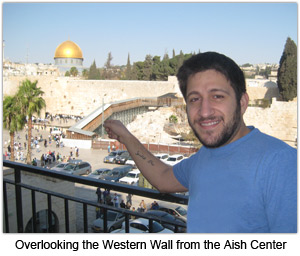
After high school I was hit with some challenges and really lost my way. I got a tattoo on my forearm – spelling out my name in Arabic letters. (see photo below)
I tried college but didn’t know what I wanted to do with my life. I made poor choices, got into trouble, and spent eight months crashing on my friend’s couch and eating corn out of a can.
Meanwhile, my sister had become part of the Aish community in Los Angeles. In time, she came back to full Jewish observance.
Slowly I got back on track. I rented a room with a Jewish family. I joined them for Shabbat dinners and for services at Aish in Denver.
After a few months, I was ready to discover the real me. I knew that the best place to start was in Israel. So I called my sister and she put me in touch with a philanthropist in LA who was willing to pay for my trip.
Everything I’ve been through has brought me to where I am right now. There’s a reason for it all.
A few weeks after arriving in Israel, I went for a long walk on Shabbat afternoon and thought about how – having been dealt a difficult hand in life – I’ve been carrying a lot of anger around. I knew that in order to move forward, I needed to let that anger go.
The classes I took at Aish Jerusalem helped me realize: Everything I’ve been through has brought me to where I am right now.
There’s a reason for it all.
Yearning to Connect
Today I am learning in yeshiva, fully embracing my life. It’s an incredible experience to be studying across from the Western Wall, at the center of history. The Torah learning is intellectually fascinating and emotionally grounding. And the guys are top-notch – bright idealists willing to take responsibility for themselves and for the world.
And yet a part of me is not yet complete.
There is an ever-present yearning to connect with my father, whom I never knew, and whom I long to know about.
So I’ve been spending time at the village in northern Israel, getting to know my aunts and uncles and many, many cousins. They’re amazing people. They are very kind and caring, and go out of the way to help each other. They shower me with love and would do anything for me.
They are my family.
I ask them questions about my father, and look at family photos. I walk the same mountain paths that my father walked.
Being there is my connection to him that I never had.
In many ways, too, I represent their connection to my father. Especially since I look almost exactly like him.
My Arab family is very pro-Israel. My uncle runs a social services organization that serves both Arabs and Jews. My aunt was the first Christian-Arab woman to be elected to the Knesset.
Underlying that support, however, is what they perceive as a social inequality. Municipal services and government allocations seem to be less for the Arab community. As much as Israeli society is sensitive to the plight of being a minority, the reality is that Israeli Arabs are the minority. Christian Arabs have it especially tough – feeling excluded by Muslims because they are Christians, and by Jews because they are Arabs.
Yet they still feel 100% “Israeli.” My cousins are highly integrated into the work force and they view their primary identity as Israeli. As Christians, they feel more closely aligned with Judaism than with Islam. In fact, one of my Arab cousins married a Jew.
I am still not comfortable showing my Judaism when I go visit.
I am still not comfortable showing my Judaism when I go visit, in terms of praying and wearing a kippah. With the Arab culture being so hospitable, it’s especially challenging for me to keep kosher.
As Israelis, they know all about Shabbat and the Jewish holidays. But it’s still strange for them to see me as a Jew, because in their culture the religious heritage follows the father. They don’t know that my father converted to Judaism, so there’s an underlying question of why I chose my mother’s religion over my father’s religion.
In that way I guess I am following the footsteps of my father – torn between a loyalty to his Arab family and to the Jewish life he so wholly embraced.
My hope is that with time, I’ll have more confidence, and that my Judaism will only enrich the good relationship we have together. And I think I can serve in some way to bridge the gap of understanding between various groups. After all, I've got lots of perspectives: Jewish and Arab, religious and secular, American and Israeli.
The Torah teaches that instead of feeling sorry for myself, I need to take responsibility and make the changes to fix things. In the end, my biggest challenge will be to close the circle of these two lives – Arab and Jew, father and son.