

Sukkot(Leviticus 22:26-23:44)

The Laws of the Four Species

The Torah says:

"You shall take ... the beautiful fruit (Etrog), a palm frond (Lulav), myrtle twigs and willow branches of the stream -and rejoice for seven days before the Lord your God." (Leviticus 23:40)

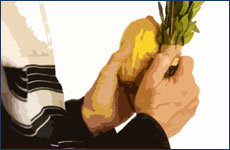
On Sukkot, we bind all the branches together - two willows on the left, one palm branch in the center, and three myrtles on the right. We hold this bundle in our right hand, and then lift them together with the Etrog. We then shake them all together, three times in each direction: front, right, back, left, up and down. (Sefardim and Chassidim have a different custom for the order.) This mitzvah should be performed during the daytime, each of the seven days of Sukkot (except for Shabbat).

Before waving the four species, we say the following blessing:

"Baruch ata Adonoy, Elo-heinu Melech ha'olam, asher kid'shanu bi'mitzvo-sav, vi'tzivanu al ni-tilas lulav."

"Blessed are You, Lord our God, King of the Universe, who sanctified us with His mitzvot, and instructed us to raise up the Lulav."

To be valid for the mitzvah, the four species must meet certain requirements. Since the details are many and technical, it is not recommended to search through the forest on your own for these species! (Particularly the Etrog, which can easily be confused with a lemon.) A better idea is to purchase a complete set from a reliable distributor. Your local Jewish bookstore may have a "Four Species Set" with a rabbinical seal certifying their validity.

To be an informed consumer, here are some basic requirements to look for:


ETROG


  • Should preferably be turning yellow rather than green.


  • The peel cannot be punctured through in any spot, nor can it lack any of its inner skin.


  • The peel cannot be overly soft, cracked, dry or peeled.


  • Even a small black dot on the upper part invalidates it.


  • The shape should preferably be like a tower ? wider at the bottom and narrow at the top.


  • If this particular Etrog grew with a protruding stem (called a pitom), then that stem cannot be broken off. (However, if the Etrog grew in the first place without a pitom, it is still kosher.)


MYRTLE


  • You will need three myrtle branches.


  • A kosher myrtle has a pattern of three leaves coming out from the same point in the branch. This three-leaf pattern must be repeated over at least half the length of the branch.


  • Each branch should be at least 11 inches (29 cm.) long.


  • The branch cannot be dried out.


WILLOW


  • You will need two willow branches.


  • The stem should preferably be red.


  • The stem should be at least 11 inches (29 cm.) long.


  • The leaves should be oblong, not round in shape.


  • The leaves should have a smooth edge, not serrated.


LULAV


  • Look at the very top of the branch and make sure that the center-most leaf is not split, but rather is closed (at least half-way down).


  • The top cannot be cut off.


  • The branch cannot be dried out.


  • It should be at least 16 inches (39 cm.) long.


  • The straighter the branch, the better.


Published: Saturday, September 25, 2004

Aish.com relies on your support. Click here to support us.

Visitor Comments: 2

  • (2) Yirmiyahu Ben-Avi , October 13, 2008

    I also found this piece to be very informative. Thank you for sharing. Hag Sameah!

  • (1) Sarai bat Abraham , September 25, 2007

    Shalom and todah rabbah. This is great and beneficial information for new converts like myself. I not only find this resource beneficial but the entire website as well. May hashem send everyone berajot who contributes to this website. SHALOM

Submit Your Comment:

  • Display my name?

  • Your email address is kept private. Our editor needs it in case we have a question about your comment.

  • * required field
Submit Comment

About the Author

Rabbi Shraga Simmons


Rabbi Shraga Simmons spent his childhood trekking through snow in Buffalo, New York. He holds a degree in journalism from the University of Texas at Austin, and rabbinic ordination from the Chief Rabbi of Jerusalem. He is the senior editor of Aish.com and the director of JewishPathways.com. He is also regarded as an expert on media bias relating to the Middle East conflict, and was the founding editor of HonestReporting.com. Rabbi Simmons lives with his wife and children in the Modi''in region of Israel.

Features at Aish.com

Most Popular

Sponsors